
Most Google Ads budgets are set by one of three bad methods: what was spent last year, what the marketing percentage allows, or what a competitor supposedly spends. All three share the same flaw — they start from the company and ignore the auction. The right budget is where your marginal cost per conversion meets the most you can profitably pay. Everything else is arithmetic.
That sounds abstract, so let’s make it a working method you can run with data you already have.
💸 Start with the only number that matters: allowable CPA
Work out what one conversion is worth: average order value and margin for e-commerce; lead-to-sale rate and deal value for lead generation (lifetime value if repeat business is real, not hoped-for). The maximum you can pay per conversion while hitting your profit requirement is your allowable CPA — the ceiling every budget decision hangs from. If you cannot state this number, no one can tell you your budget, because ‘how much should I spend?’ literally has no answer without it.
📉 Diminishing returns: budgets buy auctions, not conversions
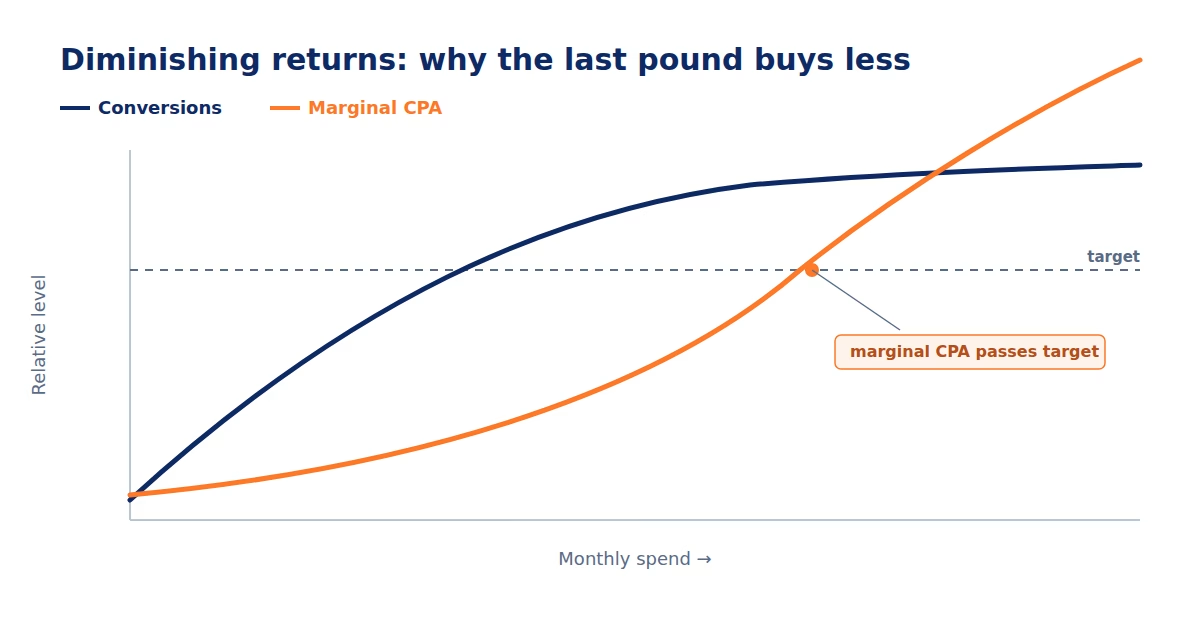
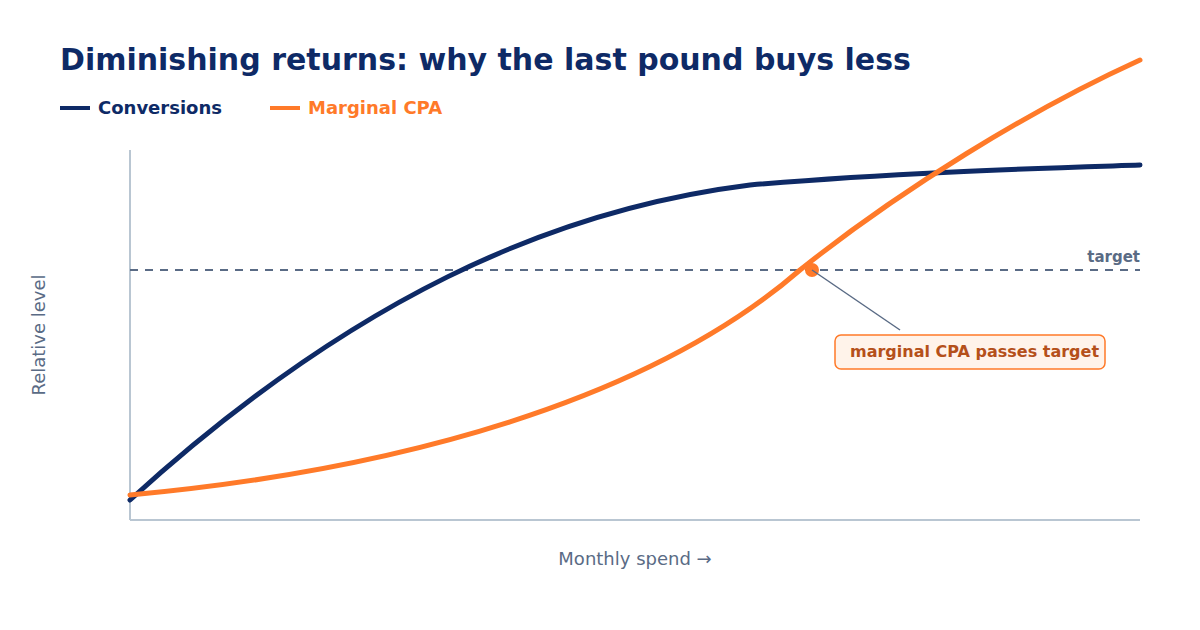
Paid search demand is finite: only so many people search your terms each month. The first slice of budget buys the cheapest, highest-intent auctions; each additional slice reaches less certain ones. So conversions grow with spend, but marginal CPA — the cost of the next conversion, not the average — rises the whole way. The right budget is the point where marginal CPA crosses your allowable CPA. Spending beyond it destroys profit while the average still looks acceptable, which is exactly why averages mislead.
The average CPA tells you how the month went. The marginal CPA tells you whether the next thousand pounds is a good idea.
🔍 Reading the signals you already have
- Search impression share — lost (budget). The clearest ‘underfunded’ signal there is: profitable campaigns losing impression share to budget are leaving money on the table. Fixing this comes before any expansion.
- Search impression share — lost (rank). Means the constraint is bids/quality, not budget. More budget here mostly buys the same auctions at the same losing position.
- Budget-limited flags and ad-schedule truncation. Campaigns that exhaust budget by mid-afternoon aren’t ‘spending their budget’ — they’re randomly sampling the day. Seasonal CPA spikes are often just this plus auction inflation, misdiagnosed as tracking problems.
- Click share on Shopping. The Shopping equivalent of impression share; low click share with strong ROAS is an expansion signal.
🪝 A staged budget plan that survives contact with reality
Stage one: fund what already works to full impression share — remove ‘lost (budget)’ from every campaign beating your allowable CPA. Stage two: expand coverage — new campaigns for uncovered products, intents or geographies, each with its own small test budget and a kill threshold decided in advance. Stage three: only now consider pushing bids/targets to buy deeper into the auction, watching marginal CPA as you go. Most accounts we audit have stage one unfinished while money is being poured into stage three, when the cheaper fix is often efficiency work on the landing page rather than more budget.
Two practical rules: hold roughly 10–15% of the total as a reallocation buffer moved monthly to whatever is beating target, and judge any change against a like-for-like window — paid search is seasonal, and April versus January proves nothing.
🧮 What ‘too small’ looks like
There is a floor below which Google Ads cannot be evaluated: if your budget cannot buy roughly 30–50 conversions a month at realistic CPCs, Smart Bidding starves and every conclusion you draw is statistical noise. In that case, narrow the scope — fewer keywords, one campaign, one location — until the data density is real. A small budget spent narrowly teaches you something; the same budget spread thin teaches you nothing.
🧩 The bottom line
The right Google Ads budget is not a number someone gives you — it is the output of a loop: allowable CPA from your economics, marginal CPA from the auction, impression share to show where headroom exists. Fund proven campaigns to full delivery first, expand coverage second, buy deeper third, and re-run the loop monthly. Any budget set without those inputs is a guess wearing a spreadsheet.
CWA Europe builds budget plans from impression share, marginal CPA and your unit economics for every online advertising & PPC client. Get in touch for an honest read on whether your budget is too small, too large, or just pointed at the wrong campaigns.
📖 Further reading: Google Ads Strategy in 2026: Build One That Pays.
References & further reading
- Google Ads Help — impression share metrics, budget reports and bid strategy documentation. support.google.com/google-ads
- Search Engine Land — analysis of auction dynamics, seasonality and budget pacing. searchengineland.com
- Search Engine Journal — guides on account structure and budget allocation frameworks. searchenginejournal.com
Image: original graphic by CWA Europe.
Frequently asked questions
Is there a minimum sensible monthly budget for Google Ads?
Think in conversions, not pounds: you want the realistic prospect of 30–50 conversions a month so automated bidding has signal and results are readable. At a £5 CPC and 3% conversion rate that implies roughly £5,000–£8,000; in a £1 CPC niche it can be far less. If the maths doesn't reach that, narrow the campaign until it does.
My campaign is 'Limited by budget'. Should I just raise it?
Only if the campaign beats your allowable CPA — then yes, and promptly, because you are rationing profitable traffic. If it's at or above allowable CPA, raising budget buys more of a marginal thing; fix efficiency (queries, negatives, landing pages, targets) first.
How should I split budget between brand and non-brand?
Fund brand fully first — it is cheap, high-converting and defensive — but keep it in its own campaign so it never masks non-brand economics. Then apply the allowable-CPA test to non-brand alone. Blended figures flatter every account and mislead every decision.
When is it right to cut the budget?
When marginal CPA exceeds allowable CPA at current spend and no efficiency fix changes that; when impression share is already near maximum so extra money can't buy delivery; or when the season genuinely ends. Cutting spend that fails those tests is saving money; cutting profitable, budget-limited spend is the most expensive saving in marketing.