

Every advertiser eventually has the meeting: three reports open, three different conversion totals, and a client asking which one is real. The honest answer is that they are all real — each system counts a different thing, at a different moment, under different privacy constraints. Understanding why they diverge is the difference between managing a campaign and arguing with dashboards.
This matters more in Europe than anywhere else. Consent banners, GDPR enforcement and browser-level tracking protection mean a meaningful slice of your conversions is never directly observed at all — it is modelled. If you do not know where the modelling starts, you cannot know what your numbers mean.
🍺 Consent Mode: what happens when users say no
With Google Consent Mode v2 — effectively mandatory for EEA advertisers since 2024 — your tags behave differently depending on the banner choice. Consent granted: the tag fires normally and the conversion is observed. Consent denied: no cookies are set, but the tag sends anonymous, cookieless pings, and Google uses those plus observed data to model conversions it believes occurred. Those modelled conversions appear in your Google Ads column with no separate label.
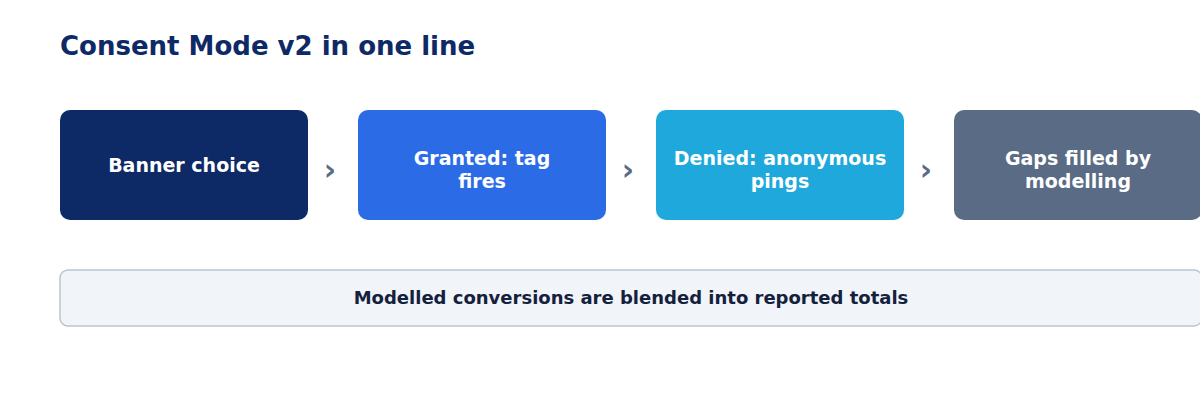
Modelling is genuinely useful — without it you would optimise on a biased subset of privacy-conscious markets. But it means your Ads number is an estimate with confidence, not a count. Expect the modelled share to be larger in DACH and Nordic markets, on Safari and Firefox traffic, and anywhere your banner design produces high rejection rates.
⚖️ Attribution and counting rules: the quiet dividers
Even with perfect measurement, systems would still disagree, because they answer different questions. Google Ads reports conversions on the date of the click, credits its own ads, and uses data-driven attribution across Google touchpoints. GA4 reports on the date of the conversion, sees (some) other channels, and applies its own attribution. Your CRM counts signed deals, weeks later, deduplicated by human beings.
- Click date vs conversion date. A click on 30 June converting on 2 July lands in June for Google Ads and July for GA4. Month-end comparisons are guaranteed to disagree.
- Attribution scope. Google Ads cannot see the email or organic touch that closed the deal; GA4 can. Each assigns credit within its own visible world.
- Counting method. ‘Every’ vs ‘one per click’ conversion counting, view-through windows, and enhanced conversions each move totals a few points on their own.
- Latency. Modelled and imported conversions arrive late. Yesterday’s number is not final; in lead-gen accounts, even last week’s may not be.
🔗 Enhanced conversions and offline imports: closing the loop
Enhanced conversions send hashed first-party data (email, phone) alongside the conversion, letting Google match conversions that cookies alone would miss — typically recovering a meaningful single-digit percentage. Offline conversion imports go further: pushing CRM outcomes (qualified lead, closed deal, revenue) back into Google Ads so Smart Bidding optimises towards what you actually bank, not form fills. For lead-gen accounts this is the single most valuable tracking upgrade available — it converts the argument about whose number is right into a bidding signal, and clean conversion data is exactly what keeps Smart Bidding honest.
The goal is not three matching dashboards. It is one number you trust enough to bid on, and a documented reason for every gap around it.
🧞 Auditing a mismatch: a 30-minute method
First, size the gap: under ~15% between Ads and GA4 is normal life; do not spend a day on it. Second, check the mechanical suspects in order: duplicate or misfiring tags (one client’s tags were quietly sending conversions to a different account entirely — it happens more than you would think), consent banner integration, conversion counting settings, and date-of-click versus date-of-conversion windows. Third, segment by browser and market: if the gap concentrates in Safari or high-rejection countries, you are looking at consent and modelling, not breakage. Single-page-application sites deserve special suspicion — client-side routing can stop tags firing on virtual page views without anyone noticing.
🧩 The bottom line
Your conversion reports disagree because they measure different events, on different dates, under different privacy rules, with different attribution. That is not a bug to fix but a system to understand. Pick the number closest to money — usually CRM-verified outcomes fed back via offline import — make it the bidding signal, and treat platform numbers as directional instruments. Then document the expected gaps, so the next ‘which number is real?’ meeting takes five minutes.
CWA Europe runs a tracking and consent audit at the start of every online advertising & PPC engagement — tags, consent flow, counting rules and CRM loop. Get in touch if your dashboards can’t agree with each other.
📖 Further reading: How to Optimize Google Ads: Best Practices for 2026.
References & further reading
- Google Ads Help — Consent Mode, enhanced conversions and offline conversion imports. support.google.com/google-ads
- Google Analytics Help — GA4 attribution settings and reporting differences vs Google Ads. support.google.com/analytics
- Search Engine Land — coverage of Consent Mode v2 enforcement and conversion modelling. searchengineland.com
Cover photo: Rahul Shah · Pexels. Diagram: original graphic by CWA Europe.
Frequently asked questions
Roughly what share of my conversions is modelled rather than observed?
It varies by market and audience, but EEA advertisers commonly see meaningful modelled shares — higher where consent rejection is high (privacy-conscious markets, Safari/Firefox traffic). Google does not label modelled conversions separately in the Ads interface, which is why understanding your banner's consent rate is essential context for every report.
Should I manage the account by the Google Ads number or the GA4 number?
Bid and optimise on the Google Ads number (ideally upgraded with enhanced/offline conversions), because that is the signal Smart Bidding consumes. Use GA4 for cross-channel context and the CRM for commercial truth. Managing by three numbers at once is how accounts end up managed by none.
My conversions dropped 30% overnight — is it tracking or performance?
Check tracking first: a genuine demand collapse is gradual far more often than vertical. Look at tag firing (Tag Assistant), recent site deploys, consent banner changes, and whether clicks and CTR held steady while conversions vanished — steady traffic with zero conversions almost always means measurement, not market.
Do I really need offline conversion imports for lead generation?
If lead quality varies at all, yes. Optimising to raw form fills teaches Smart Bidding to buy cheap, low-intent leads. Importing qualified or closed outcomes — even weekly, even manually at first — re-points the entire bidding system at revenue.