
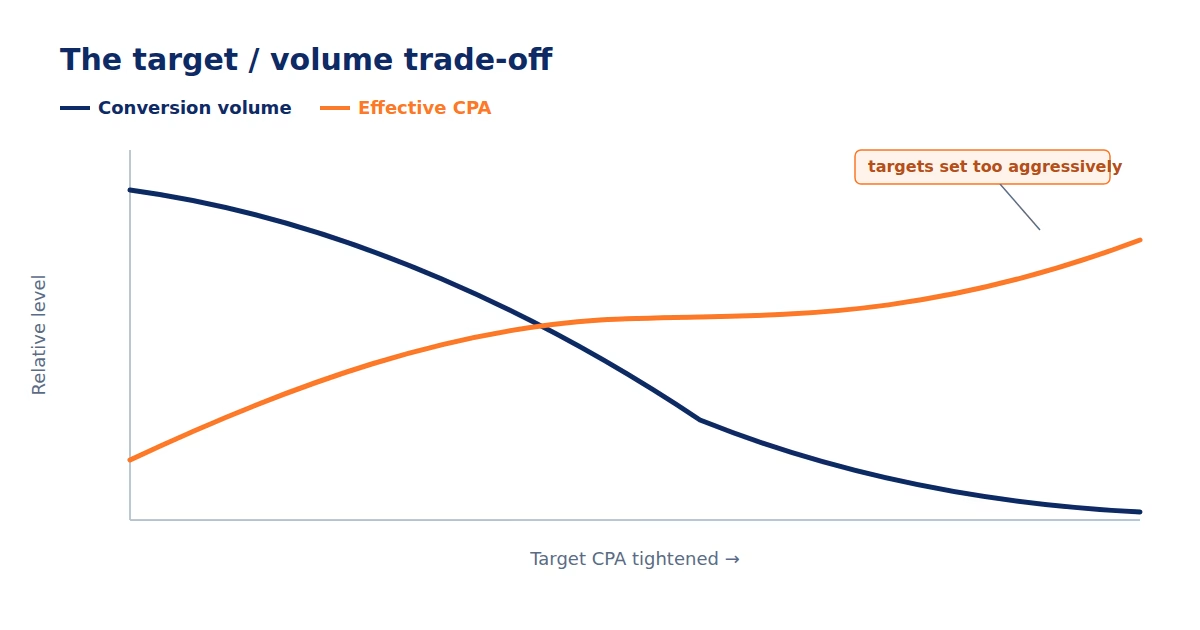
Manual CPC is, for most accounts, a solved argument: Google’s Smart Bidding sees signals no human can — device, hour, location, audience membership, query history, browser, and hundreds more — and sets a bid per auction. The question in 2026 is no longer whether to use automated bidding but how to manage it. Because Smart Bidding is not a set-and-forget product. It is an optimisation engine that does exactly what you tell it, including the things you did not realise you were telling it.
Target CPA (tCPA) and Target ROAS (tROAS) are the two strategies where advertisers most often get this wrong. Both work superbly when the target reflects reality. Both quietly strangle an account when the target reflects wishful thinking.
🤖 What the algorithm actually optimises
tCPA instructs the system to win as many conversions as possible at your average cost target. tROAS does the same for conversion value against spend. The key word is average: the system will happily pay well above your target for an auction it believes is likely to convert, balanced by cheaper wins elsewhere. If your mental model is ‘never pay more than X per click’, you will misread almost everything the strategy does.
It also means the algorithm is only as good as the conversion data you feed it. If your tracking counts junk leads, Smart Bidding will optimise towards junk leads with impressive efficiency. Garbage in, confidently-automated garbage out.
⌛ The learning phase: where impatience gets expensive
Every meaningful change — a new target, a big budget move, restructured ad groups — sends the strategy back into a learning period, typically one to two weeks. During learning, performance is volatile by design: the system probes auctions to calibrate its predictions. The classic mistake is reacting to that volatility with another change, which restarts the clock, which produces more volatility, which prompts another change.
If you change the target every time you get nervous, the algorithm spends its whole life learning and none of it performing.
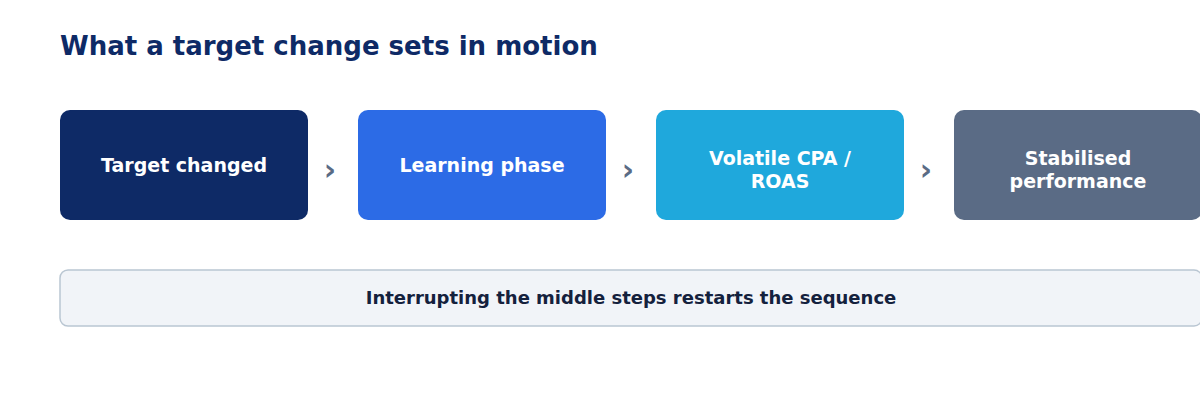
The discipline that works: change targets in steps of no more than 15–20%, wait for at least two weeks or fifty conversions (whichever is longer) before judging, and log every change so you can separate algorithm behaviour from your own interference.
📉 Why aggressive targets backfire
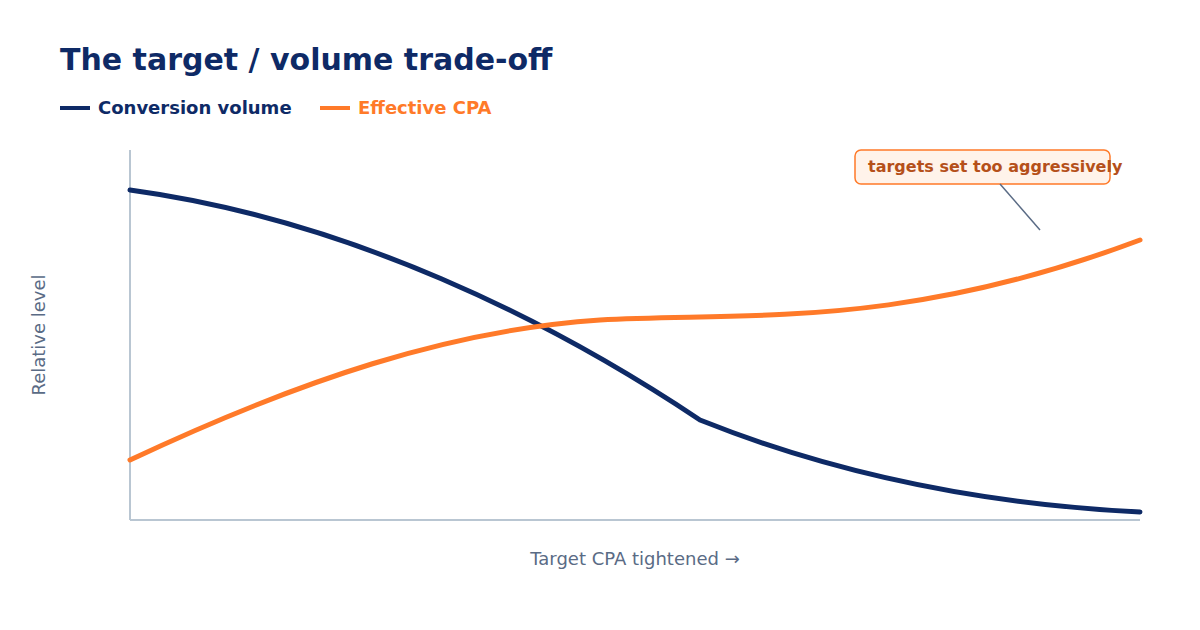
Set a tCPA far below what your market genuinely costs and the system does not heroically find you cheap conversions — it simply stops entering auctions it cannot win at that price. Volume collapses, the remaining traffic skews odd, and the account starves of the very data Smart Bidding needs. We see the same on tROAS: a 500% target on a campaign still in learning is not ambition, it is a handbrake. New campaigns should launch with realistic targets close to recent actuals, then tighten gradually once volume is stable.
🛡️ Guard-rails that keep you in control
- Set targets from data, not budgets. Your tCPA should start within 10–15% of the account’s actual trailing CPA. The number finance wants is a destination, not a starting point.
- Watch impression share, not just CPA. A beautiful CPA on collapsing ‘lost IS (rank)’ means the target is choking delivery. Efficiency on ten conversions is not a strategy.
- Use portfolio strategies deliberately. Grouping campaigns under one portfolio lets low- and high-margin campaigns share data — but it also lets one campaign hog budget. Group only campaigns with genuinely shared economics.
- Seasonality adjustments exist — use them. For short, predictable spikes (a sale weekend), a seasonality adjustment tells the system the conversion-rate change is temporary, avoiding a full re-learn afterwards.
- Never feed it conversions you don’t value. Remove or de-prioritise soft actions (page views, newsletter sign-ups) from the ‘conversions’ column, or the algorithm will buy them.
📊 Reading performance the way the algorithm does
Judge Smart Bidding on rolling 30-day windows, segmented by the things it cannot control: seasonality, promotions, site changes, competitor entries. A one-week CPA spike after a competitor doubled their budgets is auction pressure, not algorithm failure — we covered a textbook case of rising auction prices being misread as tracking breakage in our client diagnostics work. Before blaming the strategy, check auction insights and search impression share; the answer is usually there.
🧩 The bottom line
Smart Bidding is the best bid manager you will ever hire and the most literal-minded. It optimises to the target and the conversion data it is given — nothing more, nothing less. Give it honest targets, clean conversion data, stable conditions, and time to learn, and it outperforms any human. Give it a fantasy CPA and weekly interference, and it will faithfully deliver you fewer conversions at a prettier unit cost. The control you give up in bids you must reinvest in targets, measurement and patience.
CWA Europe manages Smart Bidding targets as a monthly discipline for every online advertising & PPC client — targets, learning windows and change logs included. Get in touch if your automated bidding feels more automated than managed.
📖 Further reading: Broad Match in 2026: When to Trust the Machine.
References & further reading
- Google Ads Help — official documentation on Smart Bidding, learning periods and seasonality adjustments. support.google.com/google-ads
- Search Engine Land — ongoing analysis of automated bidding behaviour and target strategy. searchengineland.com
- Search Engine Journal — practical guides on tCPA/tROAS migration and portfolio bidding. searchenginejournal.com
Images: original graphics by CWA Europe.
Frequently asked questions
How long should I wait after changing a tCPA or tROAS target?
Treat two weeks or roughly fifty conversions — whichever takes longer — as the minimum evaluation window. The learning phase produces volatility by design, and judging (or changing) the target inside that window means you are reacting to noise, not performance.
My CPA target is being ignored — some conversions cost double the target. Is it broken?
No. Both strategies optimise to an average across the period, not a cap per conversion. Expensive individual conversions are normal if the blended figure lands near target. If the blended figure consistently overshoots, the target is unrealistic for your auction or your conversion volume is too thin for the algorithm to calibrate.
Should a brand-new campaign start on tCPA?
Usually not at your final target. Launch on Maximise Conversions (optionally with a loose tCPA near recent account actuals), let it accumulate volume, then tighten in 10–15% steps. Starting a cold campaign at an aggressive target is the most common way to strangle it at birth.
What is the difference between a standard and a portfolio bid strategy?
A standard strategy optimises one campaign in isolation; a portfolio strategy pools several campaigns under one shared target and dataset. Portfolios help when campaigns are small individually but similar economically — and hurt when dissimilar campaigns are lumped together, because budget flows to whatever is easiest for the algorithm, not what matters to you.